

How to Choose Salon Grade Shampoo: A 2026 Guide
Table of Contents
- Start With Your Scalp, Not Your Hair Type
- Salon Shampoo vs Drugstore Shampoo Comparison
- How to Read a Salon Grade Shampoo Label
- How to Choose Salon Grade Shampoo for Your Hair Density and Porosity
- Best Salon Shampoo for Color Treated Hair
- How to Maintain Salon Hair at Home
- Frequently Asked Questions
Last Updated: October 4, 2026
Start With Your Scalp, Not Your Hair Type
Most people shopping for a salon grade shampoo start with their hair "type." That's wrong. Your scalp drives how much oil reaches the mid-lengths and ends, how well products rinse clean, and whether your cuticle stays smooth.
Scalp Concerns vs. Hair Shaft Needs
Your scalp and hair shaft have different requirements, and one bottle rarely solves both.
The scalp produces sebum, hosts a microbiome, and reacts to buildup, irritation, and sensitivity, including flaking, oiliness, itching, and reactivity during chemotherapy or illness recovery.
The hair shaft is dead protein with structural needs: moisture retention, cuticle health, and protection from heat and color processing.
That's why "best shampoo for dry hair" is a nearly useless label. Ask instead: does my scalp need calming, clarifying, or balancing?
Salon Shampoo vs Drugstore Shampoo Comparison
The real difference between salon and drugstore formulas comes down to concentration, surfactant quality, and pH. Not marketing.
Mass-market shampoos are engineered for shelf appeal and cost: harsher surfactants for fast lather, plus silicones that coat the strand for instant slip.
Professional formulas typically use gentler surfactant systems, a pH-balanced profile closer to hair's natural acidity, and higher concentrations of conditioning agents, so a smaller amount does more work and the bottle lasts longer than the price tag suggests.
| Factor | Salon Grade | Drugstore |
|---|---|---|
| Surfactants | Gentler, sulfate-free options common | Harsher, high-lather |
| Concentration | Higher, less product per wash | Diluted, more needed |
| pH | Balanced to hair's acidity | Varies widely |
| Color protection | AntiFade systems common | Inconsistent |
| Silicones | Often silicone-free | Frequent coating agents |
How to Read a Salon Grade Shampoo Label
Ingredient lists are ordered by concentration, so the first five tell you most of what you need. If water and a harsh surfactant lead, you're looking at a basic cleanser with marketing on the front.
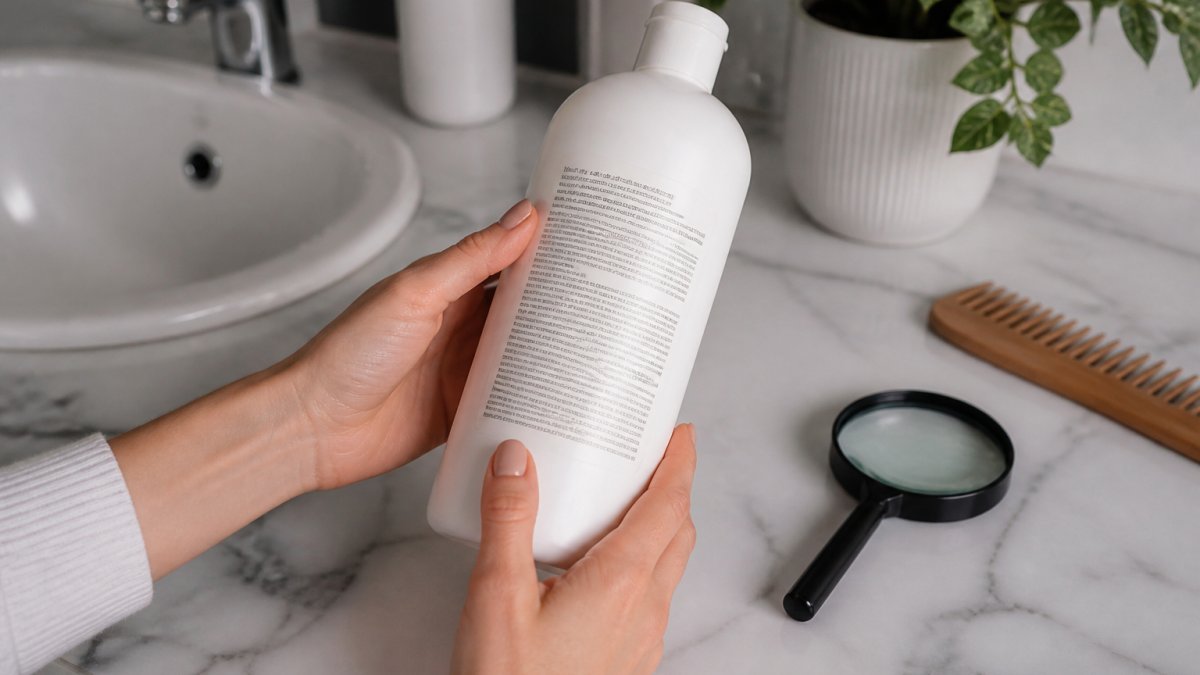
Here's how to scan a label in under a minute:
- First ingredient: Usually water. Fine. It's the base.
- Second or third: The surfactant. Sulfate-free options are gentler on color and scalp.
- Mid-list: Humectants, emollients, and hydrolyzed proteins do the conditioning work.
Surfactants, pH Balance, and What They Actually Do
Surfactants lift oil and dirt so water can rinse them away. Harsher surfactants strip color and natural oils; gentler systems clean effectively while leaving the lipid barrier more intact.
pH balance matters because the cuticle lies flattest in an acidic environment. Push pH too high and the cuticle lifts, color escapes faster, and the strand feels rough. A pH-balanced shampoo keeps the cuticle smooth, the point of color-safe washing.
Ingredients Worth Avoiding (and Why)
Not every "free-from" claim deserves your money, but a few ingredients are worth watching.
- Sulfates: Effective cleansers, but can strip color and irritate a sensitive scalp.
- Parabens: Preservatives some consumers prefer to avoid.
- Silicones: Create temporary smoothness but can build up and mask damage.
For a reactive or sensitive scalp, fragrance is often the overlooked culprit. A fragrance-free or naturally scented formula can make a noticeable difference.
How to Choose Salon Grade Shampoo for Your Hair Density and Porosity
Match the formula to two physical traits: density and porosity. Get these right and most of the guesswork disappears.
Hair density is how many strands you have per square inch.
Hair porosity is how readily strands absorb and lose moisture.
For fine, flat, color-treated hair, a weightless volumizing formula is often right. For fine, dry hair, a lightweight hydrating formula delivers moisture without weight.
The Third Variable: Your Water
This is the piece most buying guides skip, and it's often why a salon-grade shampoo that worked at the salon underperforms at home.
Municipal water in much of the country runs moderately to very hard, carrying dissolved calcium and magnesium. Those minerals bind to the cuticle, leave a dulling film, and interfere with how surfactants lather and rinse, so a formula feels like it isn't cleaning, even when it is.
Signals that water is your problem, not your shampoo:
- Hair feels coated or waxy within a day of washing, even with a clarifying formula.
- Color fades faster than expected between salon visits.
- Soap and shampoo lather poorly, and fixtures develop white scale.
What to do about it:
Pureology Pure Volume Shampoo 9 oz →
- Rotate in a chelating or clarifying wash every week or two. Chelating formulas lift mineral deposits; clarifying formulas handle product buildup. Not the same job.
- Consider a shower filter rated for hard water. It won't soften water like a whole-house system, but it reduces the mineral load reaching your hair.
- Adjust your expectations for lather. Hard water suppresses suds, so a salon-grade concentrate that lathers modestly may still clean thoroughly, don't over-apply to chase foam.
- Lean on acidic rinses. A diluted apple cider vinegar rinse, used occasionally, flattens the cuticle and lifts some surface mineral film. Maintenance, not a replacement for chelating.
Matching Density, Porosity, and Water Together
Read these three together:
- Fine + low porosity + hard water: lightweight, sulfate-free, and a chelating wash on rotation. Heavy conditioners and mineral film will both flatten this hair.
- Fine + high porosity + hard water: lightweight hydrating formula with hydrolyzed protein, plus chelating to keep the cuticle from staying rough.
- Thick + low porosity + soft water: richer conditioning is fine, but watch for product buildup rather than mineral buildup.
- Thick + high porosity + hard water: the hardest combination to keep smooth. Protein, sealing emollients, and consistent chelating all matter.
If you can only change one thing and your water is hard, start there. A great formula fighting mineral film will always lose to a good formula in soft water.
Best Salon Shampoo for Color Treated Hair
For color-treated hair, the most important feature is a color-protection system. Everything else is secondary. But "color-safe" on a label is a claim, not a specification, so it helps to know what's happening at the strand level.
Why Color Fades, Mechanically
Hair color sits inside the cuticle and, with permanent dye, within the cortex. Two forces pull it out:
- Cuticle lift during washing. When a shampoo's pH runs high, the cuticle scales raise, and dye molecules escape through the gaps. This is the mechanism most color-safe formulas are engineered to prevent.
- Water exposure itself. Even pH-neutral water causes some dye migration over time. This is why wash frequency matters as much as formula.
- UV and heat. Sunlight and hot tools oxidize dye and roughen the cuticle. No shampoo fully defends against this.
A color-protection system addresses the first two. The third is on you: heat protection and less hot-tool use.
The Surfactant Chemistry Behind Color-Safe Formulas
This is where salon-grade and mass-market diverge most, and where most guides stay vague.
Surfactants are classified by charge. The harshest cleansers are anionic, traditional sulfates like sodium lauryl sulfate and sodium laureth sulfate.
Gentler systems lean on nonionic and amphoteric surfactants, often blended with milder anionic ones.
The takeaway: look past the front-of-bottle claim and check whether the surfactant blend is built for low-irritation cleansing, not just for avoiding the word "sulfate."
What to Look For, Specifically
When comparing the best salon shampoo for color treated hair, look for:
- Sulfate-free cleansing to reduce color stripping
- An AntiFade complex or equivalent color-protection technology
- Silicone-free formulas if you want to avoid buildup dulling your color
- No parabens or mineral oil if those are on your avoid list
Rotation: The Strategy Most People Skip
A single color-safe shampoo used every wash isn't optimal. Color-treated hair benefits from cycling formulas by function:
- Most washes: a gentle, color-protecting, hydrating or volumizing formula matched to your density and porosity.
- Every week or two: a clarifying or chelating wash to remove product and mineral buildup that dulls color and flattens volume.
- As needed: a protein or bond-building treatment when hair feels stretchy or limp, followed by moisture to rebalance.
The logic: buildup kills color shine, but over-clarifying strips the oils that keep the cuticle smooth. Rotating gets you both benefits without either cost.
The Pureology lineup is often recommended for color-treated hair. The Pureology Pure Volume Shampoo 9 oz is a ZeroSulfate, 100% vegan formula that adds weightless volume and removes buildup for fine, flat, color-treated hair, with a patented AntiFade Complex to help keep color vibrant. Pair it with the matching Pureology Pure Volume Conditioner 9 oz, which uses wheat protein and sunflower seed extract to enhance volume without weighing hair down.


If your hair leans dry rather than flat, the Pureology Hydrate Sheer Shampoo 9 oz delivers lightweight hydration for fine, dry, color-treated hair in a sulfate-free, silicone-free formula. The Pureology Hydrate Sheer Conditioner 9 oz follows with silicone-free moisture that detangles and softens without buildup.

How to Maintain Salon Hair at Home
Maintaining salon hair at home comes down to technique and consistency, not more products.
A routine often recommended by stylists:
- Wet thoroughly. A full rinse before shampooing lets the surfactant spread evenly.
- Shampoo the scalp only. Massage with fingertips, not nails. The ends get cleaned as suds rinse through.
- Rinse with cooler water. Cooler water helps seal the cuticle and preserve color.
- Condition mid-length to ends. Keep conditioner off the scalp unless it's a scalp-specific product.
- Rotate your products. Alternating a hydrating and a clarifying formula prevents buildup without over-stripping.
- Add heat protection before styling. This single step preserves color and reduces breakage more than any shampoo swap.
One habit worth building: rotate in a clarifying wash every week or two if you use styling products regularly.
The water you wash with matters too. Hard water leaves mineral deposits that dull color and rough up the cuticle.
Choosing the right salon grade shampoo isn't about chasing the most expensive bottle.
Frequently Asked Questions
What makes a shampoo salon grade?
Salon grade shampoo is defined by three things: a concentrated formula, a pH-balanced surfactant system, and a higher percentage of active ingredients like hydrolyzed proteins, amino acids, and botanical extracts. Professional formulas typically skip harsh sulfates and use gentler surfactants that clean without stripping the lipid barrier. They also avoid fillers that dilute performance. The result is a shampoo where a quarter-sized amount does what a palmful of drugstore product cannot, which is why salon brands often cost more per bottle but last longer.
Are salon brand shampoos actually better for your hair?
They can be, but only when the formula matches your hair's needs. Salon shampoos generally use higher concentrations of conditioning agents, humectants, and emollients, and they are more likely to be pH-balanced and sulfate-free. That matters most for color-treated, fine, or chemically processed hair. If your hair is healthy, uncolored, and low-maintenance, a well-formulated drugstore option may work fine. The real difference shows up in moisture retention, cuticle health, and how long color stays vibrant.
How often should you switch your salon-grade shampoo?
You do not need to rotate shampoos on a fixed schedule, but rotating two formulas, one clarifying and one hydrating, every few weeks helps prevent scalp buildup and keeps hair responsive to conditioning. If your hair suddenly feels flat, greasy, or dull despite regular washing, that is a sign product residue has accumulated. A clarifying wash once every two to three weeks, plus a deep conditioning treatment, usually resets things without a full product overhaul.
Do professional shampoos contain different ingredients than drugstore brands?
Yes, and the difference is concentration and surfactant choice. Salon formulas often use milder surfactants like sodium cocoyl isethionate instead of sodium lauryl sulfate, which reduces stripping. They also tend to include more hydrolyzed proteins, amino acids, and botanical extracts at levels that actually affect hair. Drugstore shampoos frequently rely on heavier synthetic fragrance and silicone blends for instant slip. Neither is inherently harmful, but salon formulas are built to support long-term cuticle health rather than immediate surface feel.