

Natural Home Goods for Sensitive Skin: 2026 Guide
Table of Contents
- What Counts as Natural Home Goods for Sensitive Skin
- Gentle Bath Products for Sensitive Skin: Cleansers, Oils, and Moisturizers
- Fragrance-Free Laundry Detergent for Sensitive Skin and What Else Goes in the Wash
- Natural Fibers for Sensitive Skin: Clothing, Sheets, and Towels
- Bedding for Sensitive Skin: Building a Comfortable Sleep Setup
- How to Introduce New Natural Home Goods Safely
- Frequently Asked Questions
Last Updated: October 9, 2026
What Counts as Natural Home Goods for Sensitive Skin
Natural home goods for sensitive skin are made with plant-based, mineral, or animal-derived ingredients instead of synthetic fragrances, dyes, and harsh preservatives, and they extend well beyond skincare.
Your skin touches dozens of surfaces daily, and each can carry an irritant: a fragranced body wash, a dye-loaded detergent, or a rough polyester sheet can trigger redness, itching, or dry patches.

That's why the natural home goods category now covers four main areas:
- Bath and body: gentle cleansers, moisturizers, and oils
- Laundry: fragrance-free detergent and fabric care
- Bedding and textiles: natural fibers that breathe
Most guides stop at skincare, but detergent residue in your pajamas matters as much as your lotion.
American Academy of Dermatology guidance on sensitive skin care
Ingredients to Avoid in Products That Touch Your Skin
The fastest way to calm reactive skin is subtraction, not addition: remove the irritants already in rotation before buying more.
Watch for these on labels:
- Synthetic fragrance and "parfum", the leading cause of cosmetic contact reactions
- Sulfates (SLS, SLES), strip the skin barrier and leave it tight and itchy
- Parabens and phthalates, common preservative and plasticizer additives
- Synthetic dyes (FD&C colors), added purely for appearance
If a label lists "fragrance" without saying what's in it, treat it as a question mark. Fragrance-free formulas are the safer starting point for known sensitivities.
Gentle Bath Products for Sensitive Skin: Cleansers, Oils, and Moisturizers
Gentle bath products for sensitive skin replace stripping surfactants with oils, milks, and soothing botanicals that clean without damaging the skin barrier. Look for short ingredient lists built on olive oil, goat's milk, honey, aloe vera, and oatmeal.
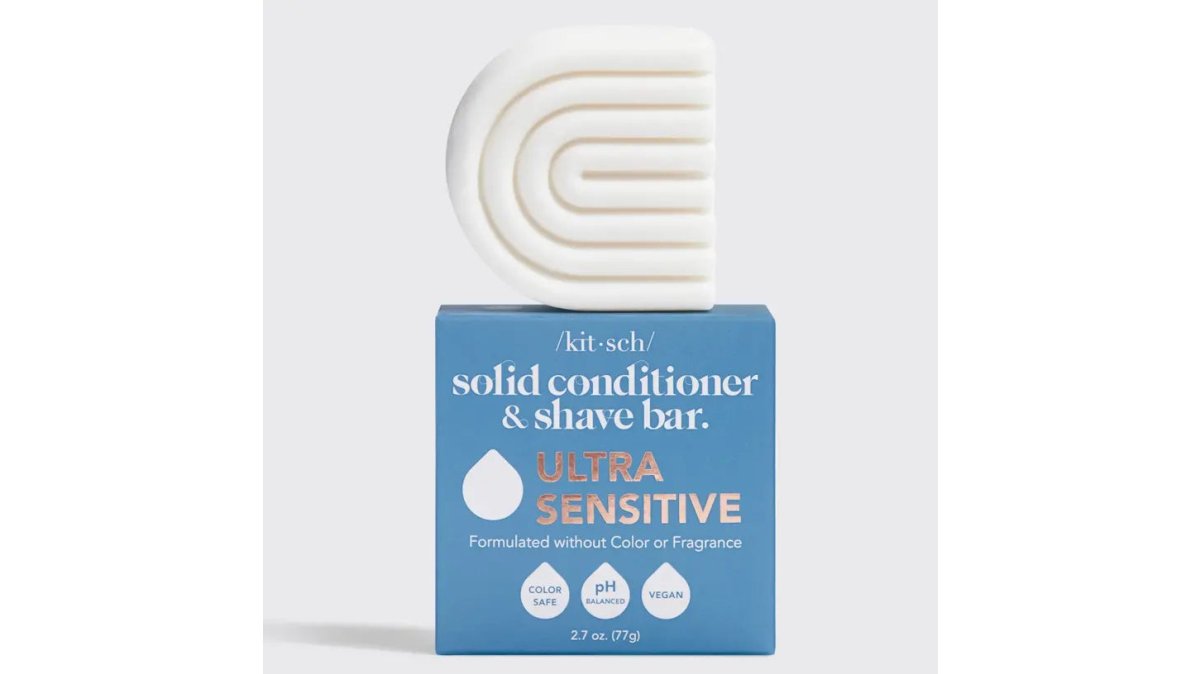
Our Ultra Sensitive Shampoo & Body Wash Bar ($14.00) is a good example of the category done right: a five-ingredient, fragrance-free 2-in-1 bar that's clinically tested and free of sulfates, parabens, phthalates, silicones, and colorants. The matching Ultra Sensitive Conditioner & Shave Bar ($14.00) works the same way on hair and skin, and doubles as a shave bar.

For heavier moisture, the Lotion ($9.00, 8 oz) and Body Butter ($14.00, 7.5 oz) from Chilton Bee Company come in scents like Oatmeal Milk & Honey and Lavender Vanilla.
Fragrance-Free Versus Naturally Scented
Fragrance-free means no scent is added; naturally scented products use essential oils or plant extracts. Neither is automatically better, they suit different people.
Essential oils like lavender, peppermint, and tea tree are natural but still common irritants. If you've reacted to scented products before, start fragrance-free and reintroduce scent later. If you tolerate botanicals, our Lavender + Mint Handmade Tallow and Goat Milk Soap Bar ($9.99) offers scent without synthetic fragrance.
Fragrance-Free Laundry Detergent for Sensitive Skin and What Else Goes in the Wash
Fragrance-free laundry detergent for sensitive skin is the most overlooked swap in a sensitive-skin routine. Residue from detergent, dryer sheets, and fabric softener sits against your skin for hours and frequently triggers itching. Unlike a body wash you rinse off, laundry products stay in the fabric and re-expose your skin every time you sweat or move.
Why residue causes problems
Detergents combine surfactants that lift oils and soil with builders, enzymes, optical brighteners, and fragrance. Most rinses away, but a high-efficiency cycle with cold water and a full drum leaves more behind, film that collects in seams, collars, and waistbands where friction is highest.
Fabric softeners make it worse: they deposit a waxy, positively charged layer designed to stay on fabric, and dryer sheets do the same with heat-activated coatings. For reactive skin, remove the coating entirely rather than find a gentler version.
What to look for on a detergent label
- "Fragrance-free" versus "unscented." Fragrance-free means no fragrance is added. Unscented can mean fragrance was added to mask the base formula's smell.
- Dye-free. Look for no FD&C colors or "blue," "green," or "yellow" dye listings. Dyes serve appearance only.
- Surfactant type. Plant-derived surfactants (coconut- or palm-derived) are common in gentle formulas, but the base chemistry matters less than whether the formula rinses clean.
- Enzymes. Proteases and amylases break down protein and starch soils. They work at low temperatures but can irritate some people.
How much to use, and how to rinse it out
Most people use two to three times the recommended amount, but more detergent just leaves more residue. Start with the lowest dose on the cap for your load size and soil level, and increase only if clothes come out visibly soiled.
- Switch to a fragrance-free, dye-free detergent
- Skip dryer sheets and liquid fabric softener entirely
- Add a second rinse cycle if your machine has one
- Use less detergent than the bottle suggests; more isn't cleaner
Your washing machine itself holds residue. Run a hot water cycle with an empty drum monthly to clear old detergent and softener buildup. With a front-loader, wipe the door gasket and leave the door ajar between loads to prevent mildew film.
A note on "natural" laundry products
Plant-based and "natural" detergents can still contain fragrance, essential oils, and preservatives that trigger reactions, natural describes an ingredient's source, not its irritation potential. For laundry, a fragrance-free, dye-free formula with a short ingredient list beats a botanical-heavy one.
For items that touch your face, the Microfiber Face Towels 3pc Set ($10.00) is machine washable and gentle enough for sensitive, mature, or irritated skin. Wash with fragrance-free detergent and hang to dry, skip the dryer sheet, since heat and coating defeat a soft, low-residue cloth.
Gentle Care Duo for Mom + Baby Kit →

American Academy of Dermatology guidance on laundry and skin irritation
Natural Fibers for Sensitive Skin: Clothing, Sheets, and Towels
Natural fibers for sensitive skin let air move and moisture escape, keeping itchy skin calmer than synthetics. But "natural" is only the starting point: two cotton shirts can behave very differently depending on how the fiber was grown, finished, dyed, and woven, often where the irritation actually comes from.
The shortlist, with trade-offs
- Cotton. Breathable, easy to wash, the safest default. Long-staple and organic versions feel smoother and pill less. Downside: it holds moisture, so it can feel damp during heavy sweating.
- Linen. Highly breathable and gets softer with each wash; wicks and dries faster than cotton. Downside: the initial weave can feel rough, and it wrinkles, which pushes some people toward wrinkle-free finishes.
- Bamboo. Silky and moisture-wicking, good for warm sleepers. Lyocell-type bamboo uses a closed-loop process and tends to be smoother than bamboo viscose. Downside: "bamboo" on a label doesn't tell you which process was used.
- Silk. Smooth against the skin, ideal for pillowcases because it reduces friction on the face and hair. Downside: it needs gentle washing and is the most expensive per item.
The finish matters more than the fiber
The finish matters most. "Wrinkle-free," "no-iron," "easy-care," and "permanent press" treatments coat fabric in formaldehyde-based resins, a known irritant. The treatment bonds to the fabric, doesn't fully wash out, and can off-gas over time, that faint chemical smell on new sheets is the finish.
Other finishes to watch for:
- Stain-repellent and water-repellent coatings, often fluoropolymer-based, applied to table linens, aprons, and some bedding
- Antimicrobial treatments, added to towels, socks, and activewear, frequently using silver or quaternary ammonium compounds
- Softener finishes, applied at the mill to make cheap fabric feel plush, which can leave a residue similar to fabric softener
Untreated fabric is the safer default. It wrinkles more and may feel stiffer at first, but it softens with washing and doesn't carry a chemical coating against your skin.
Dyes, weave, and what actually touches you
Dye is the other variable. Dark, saturated colors need more dye and fixatives than light or undyed fabric, so undyed, naturally colored, or light-colored textiles are a lower-risk starting point for reactive skin, for sheets, towels, and clothing alike.
Weave matters too: a tight, smooth weave creates less friction than a loose or nubby one, which is why sateen and percale behave differently even in 100% cotton.
Care practices that protect the fiber and your skin
- Wash new clothing and sheets before first use to remove sizing and finishing agents
- Use fragrance-free, dye-free detergent and skip fabric softener
- Choose the warmest wash the care label allows, since heat helps rinse out residues
- Dry on low or line dry; high heat can set wrinkles and degrade natural fibers
If you're rebuilding a bedroom around sensitive skin, start with the layer closest to your face and work outward: pillowcase, then sheets, then comforter. That order gives the biggest reduction in skin contact for the least money.
Bedding for Sensitive Skin: Building a Comfortable Sleep Setup
Bedding for sensitive skin should be breathable, washable, and free of chemical finishes, because you spend a third of your life against it. Build the setup in layers.
| Layer | Best Choice | Why It Helps |
|---|---|---|
| Pillowcase | Silk or high-thread cotton | Less friction on face and scalp |
| Sheets | 100% cotton or linen | Breathable, no chemical finish |
| Comforter | Cotton or bamboo fill | Temperature-regulating |
| Wash routine | Fragrance-free detergent, hot water | Removes residue and dust mites |
If allergies are part of the picture, wash bedding weekly in hot water, dust mites are a common trigger for nighttime itching, and hot water is the most reliable way to reduce them.
How to Introduce New Natural Home Goods Safely
Introduce one new product at a time and give it a week before adding the next, the only reliable way to know what your skin tolerates.
Here's the sequence we recommend:
- Patch test any leave-on product on your inner forearm for 24 hours
- Swap one category at a time (bath products first, then laundry, then bedding)
- Keep a simple log of what you changed and when
- Wait 5-7 days before introducing the next product
If redness, swelling, or itching persists after you've removed irritants, see a dermatologist. Sensitive skin is manageable at home, but persistent reactions can signal a condition needing professional diagnosis.
Rebuilding a household around sensitive skin takes patience, and the trial-and-error phase is where most people give up.
Frequently Asked Questions
What natural fabrics are best for sensitive skin?
Cotton, bamboo, silk, and linen are the natural fibers most often recommended for sensitive skin. Cotton is breathable and easy to wash, bamboo feels soft and moisture-wicking, and silk reduces friction against the skin. Look for fabrics with minimal dyes and finishes, and always wash new items before wearing them to remove manufacturing residue that can trigger irritation.
Is cotton or bamboo better for sensitive skin?
Both work well, but they suit different needs. Cotton is durable, widely available, and easy to wash at higher temperatures, which helps remove irritants. Bamboo is softer and more moisture-wicking, which can help with itchy skin during sleep. If you overheat at night, bamboo bedding may be more comfortable. If you want a fabric that holds up to frequent washing, cotton is the practical pick.
What bedding is best for people with sensitive skin?
Choose bedding made from natural fibers like cotton, bamboo, or linen, and wash it with a fragrance-free laundry detergent for sensitive skin. Avoid sheets with heavy dyes, wrinkle-resistant finishes, or synthetic blends that trap heat and moisture. A breathable cotton or bamboo sheet set, washed weekly, reduces the buildup of irritants that can cause visible redness and itchy skin.
Which laundry products are gentle on sensitive skin?
Fragrance-free, dye-free detergents are the safest starting point for sensitive skin. Skip fabric softeners and dryer sheets, which leave a residue that can trigger skin irritation. Use the recommended amount of detergent, not more, and consider an extra rinse cycle. For bedding and clothing, a fragrance-free laundry detergent for sensitive skin keeps the fabric clean without leaving irritants behind.
Are natural products always better for sensitive skin?
Not always. Some natural ingredients, like essential oils, can cause reactions in people with skin sensitivities. What matters is the specific formula, not the label. Fragrance-free products with short ingredient lists are often safer than naturally scented ones. Patch test any new product on a small area first, and stop using it if you notice irritation or visible redness.