

Salon Grade Hair Products for Home: 2026 Guide
Table of Contents
- Why Salon Grade Hair Products for Home Use Actually Matter
- How to Choose Professional Shampoo for Your Hair Type
- Best Professional Hair Masks for Damaged Hair
- Maintaining Salon Results at Home: Daily and Weekly Routines
- Styling Essentials and Thermal Protection for Home Users
- Cost-Per-Use: Why Salon Grade Hair Products for Home Save Money
- Sensitive Scalp and Recovery Care: What to Look For
- Frequently Asked Questions
Last Updated: September 27, 2026
Why Salon Grade Hair Products for Home Use Actually Matter
The gap between what your stylist uses in the chair and what sits in your shower is usually why your blowout never looks the same two days later. Salon grade hair products for home use are professional formulations sold outside the salon chair: retail formulas are built for shelf appeal, professional ones for results. At Main Street Stylists Boutique, we stock them because the difference shows up within a week.
How to Choose Professional Shampoo for Your Hair Type
Choosing the right professional shampoo starts with two questions: how porous is your hair, and how does your scalp behave? Answer those and the shelf stops being overwhelming. Most people buy by scent or brand, then wonder why their hair feels heavy or stripped.
Understanding Hair Porosity and Texture
Hair porosity is your hair's ability to absorb and retain moisture, and it decides which formulas work for you. Low-porosity hair resists moisture and does better with lightweight, protein-free formulas. High-porosity hair drinks moisture fast and loses it just as quickly, so it needs heavier conditioners and bond-building ingredients.
Reading Labels: Sulfate-Free and pH-Balanced Formulations
Sulfate-free and pH-balanced are the two label claims worth understanding before you buy. Sulfates are harsh detergents that strip color and natural oils; sulfate-free formulas clean with gentler surfactants. pH-balanced means the formula sits close to hair's natural acidic range, keeping the cuticle flat and color locked in. If you color your hair, both matter more than any single ingredient.
Best Professional Hair Masks for Damaged Hair
The best professional hair masks for damaged hair fall into two camps: bond builders and deep conditioners. They do different jobs, and using the wrong one wastes money. Bond builders repair broken protein structures inside the hair; deep conditioners coat and soften the outside.
Bond Builders vs. Deep Conditioners
| Mask Type | What It Does | Best For | Frequency |
|---|---|---|---|
| Bond builder | Rebuilds broken protein bonds | Color-treated, heat-damaged hair | 1-2x weekly |
| Deep conditioner | Adds moisture and softness | Dry, brittle, frizzy hair | 1x weekly |
| Protein treatment | Strengthens weak strands | Over-processed, limp hair | Every 2-3 weeks |
A mistake we see constantly: people use protein masks weekly and end up with stiff, snapping hair. Protein overload is real. Alternate protein with moisture and your hair stays balanced.
Application Techniques for Maximum Absorption
Application technique decides whether a mask works or just sits on top of your hair. Start on damp, towel-dried hair, not soaking wet. Water dilutes the formula and most of it rinses down the drain. Section your hair and work the mask from mid-length to ends, avoiding the scalp unless the product is designed for it. Leave it on for the full time on the label.
Maintaining Salon Results at Home: Daily and Weekly Routines
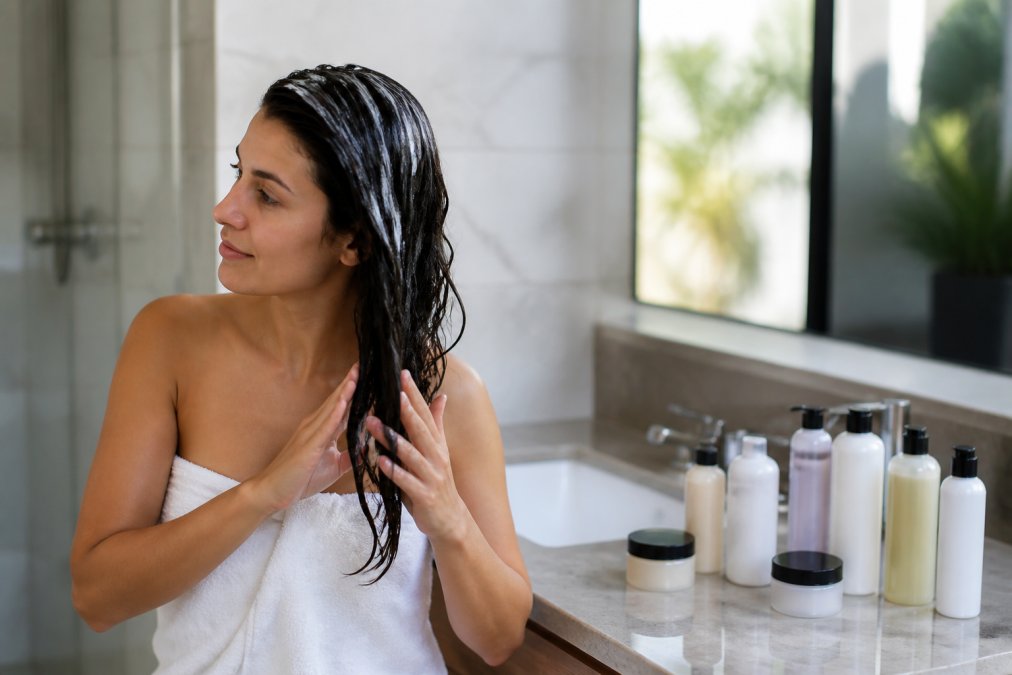
The Daily Rhythm (and the Mechanism Behind Each Step)
Shampoo 2-3 times weekly, not every day. Every wash lifts the cuticle and swells the cortex with water, which makes wet hair fragile and gradually pushes color molecules out. Stretching washes lets the cuticle lay flat again and lets your scalp redistribute its own sebum down the strand.
The Weekly Rhythm
- Deep condition once. Apply to damp, towel-dried hair, cover with a plastic cap, and let body heat do part of the work. The cap traps moisture and keeps the cuticle lifted so conditioning agents penetrate rather than sit on the surface.
- Clarify once every two weeks. Buildup from styling products, hard water minerals, and silicones blocks everything you apply afterward. A clarifying wash resets the canvas. Heavy daily styling products: weekly is fine. Gentle formulas twice a week: every two weeks is enough.
- Check your scalp, not just your hair. Flaking, tightness, or tenderness is a signal to reduce surfactant strength or frequency before it becomes a bigger problem.
The Mistake That Undoes Everything
Over-washing is the fastest way to undo a fresh salon color, and it is the single most common pattern stylists see in clients who say their color "fades too fast." Daily shampooing strips the oils your scalp needs and accelerates cuticle swelling, which is what lets color molecules escape. The American Academy of Dermatology's hair care guidance recommends washing less often for most hair types.
Styling Essentials and Thermal Protection for Home Users
Styling essentials and thermal protection are where home routines most often fall short. Heat is the biggest source of daily damage, and most people skip protection because they don't feel the harm, the damage is cumulative and invisible until the ends split.
How a Heat Protectant Actually Works
A heat protectant is not a single ingredient; it is a delivery system. Most professional formulas combine three things: a film-former (often a silicone or polymer) that creates a physical barrier between tool and cuticle, a humectant (like glycerin or a glycol) that holds moisture inside the cortex so it doesn't flash off as steam, and sometimes a protein or amino acid that temporarily fills gaps in the cuticle so heat glides across a smoother surface.
Match the Protectant to the Tool
| Tool | Typical Temperature Range | Best Protectant Format | Why |
|---|---|---|---|
| Blow-dryer | 150-200°F at the nozzle | Lightweight spray | Even distribution across damp, sectioned hair |
| Curling iron | 300-400°F | Cream or serum | Holds the barrier in place as the barrel wraps the hair |
| Flat iron | 350-450°F | Serum or heat-activated spray | Needs the highest thermal stability and slip |
A common pattern is buying one spray for everything. That works better than nothing, but a serum for flat-ironing and a spray for blow-drying is the difference between protection on paper and protection in practice.
The Rest of the Kit
- A lightweight leave-in for detangling and frizz control. Apply to damp hair, mid-length to ends, before you comb. Leave-ins are also your best defense against the mechanical damage of detangling, which causes more breakage than most people realize.
- A finishing oil for shine on dry ends. Oil does not moisturize, it seals. Use it last, on dry hair, and keep it off the roots.
- A flexible-hold styling product that won't weigh hair down. Look for a medium-hold formula if you want movement; hard-hold gels and pomades are for structured styles, not everyday wear.
- A wide-tooth comb and a sectioning clip set. Sectioning is the unglamorous tool that makes every other product work better, because it lets you apply product evenly instead of guessing.
Application Technique: The Part Nobody Teaches
Spray or apply the protectant to damp, not soaking wet, hair, water dilutes the film-former and most of it ends up on the floor. Section hair into four to six clips, then work from the bottom up. Hold the spray 6-8 inches from the section and mist in a sweeping motion rather than a direct blast, which concentrates product in one spot and leaves the rest of the strand bare.
Cost-Per-Use: Why Salon Grade Hair Products for Home Save Money
Cost-per-use is the argument that changes minds about salon grade hair products for home use. A professional shampoo costs more per bottle but lasts longer because you use less each wash. Divide the bottle price by the washes it delivers and the gap with drugstore products often narrows or disappears.
Sensitive Scalp and Recovery Care: What to Look For
Sensitive scalp and recovery care demand fragrance-free, gentle formulas, especially during chemotherapy or post-surgical healing. The scalp is skin, and it reacts to harsh surfactants and synthetic fragrance the same way the rest of your body does. When the scalp is compromised, less is more.
Look for:
- Fragrance-free and dye-free formulas
- Gentle, sulfate-free surfactants
- Soothing ingredients like aloe, oatmeal, or chamomile
- pH-balanced formulas that respect the scalp barrier
Frequently Asked Questions
What is the difference between drugstore and salon grade hair products?
Salon grade hair products typically use higher concentrations of active ingredients like bond builders, proteins, and pH-balanced formulas. Drugstore products often rely on fillers and sulfates that can strip color-treated hair. Salon-grade formulas are designed to address specific hair concerns such as porosity, damage, and frizz control, delivering more noticeable results with less product per use.
How do I know which professional shampoo is right for my hair type?
Start by identifying your hair texture (fine, medium, coarse) and porosity (how quickly hair absorbs water). Fine hair benefits from lightweight, volumizing formulas, while coarse or curly hair needs moisture-rich, sulfate-free options. If your hair is color-treated, look for pH-balanced shampoos. A professional stylist can assess your hair density and scalp health to recommend the best match.
Are salon grade hair products worth the extra cost?
Yes, when you calculate cost-per-use. Salon-grade products are more concentrated, so you use less per wash. A single bottle can last two to three times longer than a drugstore equivalent. Over a year, the difference in cost is often minimal, while the improvement in hair health, shine enhancement, and color retention is significant. They also reduce the need for frequent trims and corrective treatments.
Can I use salon grade hair products if I have a sensitive scalp or am undergoing treatment?
Look for fragrance-free, sulfate-free, and pH-balanced formulas specifically designed for sensitive scalps. Avoid products with harsh exfoliants or high alcohol content. Many professional lines offer gentle, hydrating options with ingredients like aloe and oatmeal. Always patch-test first, and consult your dermatologist or oncologist before introducing new products during treatment or recovery.
The hardest part of salon grade hair care isn't finding good products. It's knowing which ones fit your hair, your scalp, and your routine before you spend money guessing. Main Street Stylists Boutique takes the guesswork out with a stylist-curated selection, salon-approved essentials, and recovery-focused care packages for sensitive scalps and healing bodies. Get started with Main Street Stylists Boutique and bring the salon experience home, every wash.